
Telecalling CRM
Telecalling CRM by Field Team Tracking
Think of a telecalling CRM as the memory of a phone sales desk. Each lead carries its calls, their outcomes and the next callback, so spreadsheets of numbers retire. Field Team Tracking gives every telecaller a personal lead queue and shows the owner each call the team makes.
- Leads handed out to telecallers, each with a pending queue
- Caller details on screen before the call is picked up
- Callbacks that ring on the due minute
What is a telecalling CRM?
Phone sales teams use a telecalling CRM to hold their leads, write down how each conversation went, and line up the next attempt.
Field Team Tracking pairs that record with an auto dialer and a team call log for the owner.
- One lead history: calls, WhatsApp, notes and reminders.
- Stages you name, colour and reorder yourself.
- Field visits can join the same lead when the call turns into a meeting.
Telecalling CRM: how a telecaller’s day runs
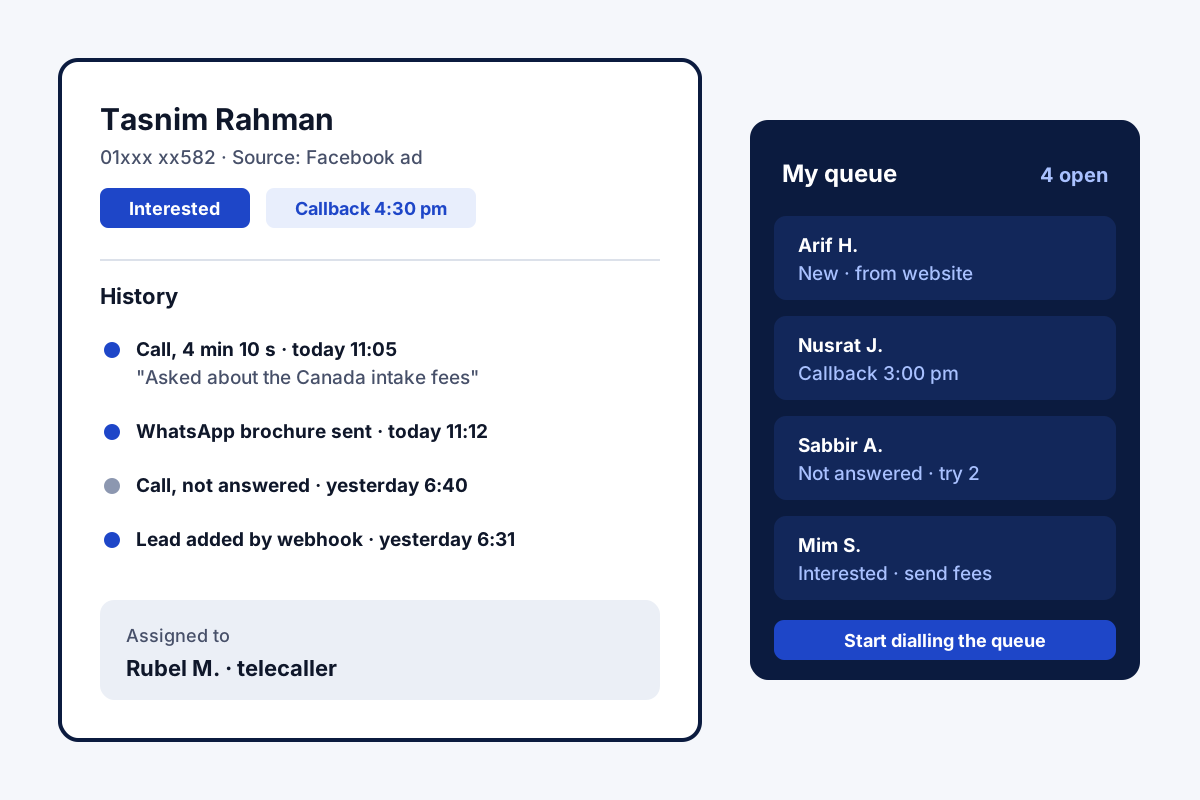
A telecalling CRM turns a pile of numbers into a working queue. In Field Team Tracking, the owner hands leads out, and each telecaller opens the app to a personal pending list. Calls can go one by one or through the auto dialer. When a lead calls back, the screen names them before the telecaller answers and shows the stage and the last remark, so the talk starts where it stopped. Mid-call, one tap reveals the complete record: earlier calls, WhatsApp chats, notes and reminders, each in a tab. Hanging up brings a form forward for the new stage and the callback time; speaking the remark is fine. On the due minute, an alarm goes off for the callback. Throughout the day the owner watches a single list of the team’s calls, each with its duration. If a hot lead wants a visit, a field rep can take it, and the visit note lands on the same lead.
Telecalling CRM benefits
A queue per telecaller
Each person works only the leads assigned to them.
Caller card
Know the lead and the last talk before picking up.
Your own stages
Name, colour and order the steps of your sales process.
Callbacks on time
The phone rings an alarm when a callback falls due.
Owner call view
Every telecaller's calls with time and length.
Built-in dialer
Work a whole queue without typing numbers.
Telecalling CRM software for teams that also visit
Many phone teams hand warm leads to field staff. Here both groups share one lead, so the telecaller sees the visit note and the field rep sees the call history. The sales team tracking app page explains the field side, and the auto dialer app page shows how a queue is dialled. A telecaller’s morning is pictured on the telecaller app page. The incoming side sits on the call management app page, and a first-day trial plan on the telecalling software page. Teams weighing a desk phone system can compare on the call management software page, and dialling straight from lead filters is shown on the CRM with dialer page. Leads who prefer messages over calls can be reached as a group with the bulk WhatsApp sender, and the callback routine is covered on the lead follow up CRM page. Eleven SIM-based options are compared on the best telecalling CRM page.
Recordings
The app never captures audio itself. If the handset has a built-in recorder, the app fetches its files and attaches each one to the matching call. A telecaller can also share a file in by hand.
Telecalling CRM through one lead
| Moment | What the telecaller does | What the CRM keeps |
|---|---|---|
| Lead arrives | Nothing; it is assigned by the owner or by turns | Source and owner |
| First call | Dials from the queue or the dialer | Call time and length |
| Call ends | Picks a stage and a callback time | Stage change and remark on the history |
| Callback due | Answers the alarm and calls again | A second call on the same lead |
| Meeting agreed | Hands the lead to a field rep | Transfer with its history |
| Deal won | Marks the lead as a paid client | Sale with paid and due amounts |
Telecalling CRM setup
- Install the app on each telecaller’s phone.
- Create the stages your team uses, from new to won.
- Import leads from Excel or a Google Sheet, or connect a webhook.
- Assign the leads and ask each telecaller to clear their queue.
Telecalling CRM price
The annual plan bills ₹1,908 per telecaller, which is ₹159 a month; the quarterly plan bills ₹747, which is ₹249 a month. Outside India the same plans cost 29 and 12 US dollars. Tax is not included. A full team can try every feature for 3 days.
Telecalling CRM limits
- Cloud phone lines. Each call leaves from a handset SIM or through WhatsApp; virtual numbers and IVR menus are not offered.
- Own recording. Audio depends on the handset’s recorder, so phones without one give no recordings.
- Desktop calling. A computer can pass a number to the paired phone, but the call itself always happens on the phone.
- iPhone history. Calls placed on iPhones stay out of the shared log, as iOS keeps that data closed.
Telecalling CRM example: an education counsellor team in Dhaka
Made-up team, used to show the flow. A study-abroad agency in Dhaka has 6 telecallers and 300 new enquiries a week from social ads. Leads lived in a shared spreadsheet, and two counsellors often phoned the same student.
Now the webhook drops each enquiry into the CRM and hands them out in turns, about 50 each. Callbacks ring on time, so fewer students go cold. When a student agrees to visit the office, the lead moves to a counsellor there, with every past call attached. Double calls stop, because each student belongs to one queue.
Telecalling CRM FAQ
What is the best CRM for telecalling?
For a phone team whose calls often lead to visits, Field Team Tracking works well, since the same lead carries the calls, the callbacks and the field stops. A pure inbound support desk may prefer helpdesk software.
What is Field Team Tracking?
Field Team Tracking is a telecalling CRM with a built-in auto dialer, attendance and live location, so office telecallers and field reps work from the same leads.
How much does a telecalling CRM cost with Field Team Tracking?
Each telecaller on Field Team Tracking costs ₹249 per month under a three-month bill, or ₹159 per month under an annual bill of ₹1,908. International teams pay 12 US dollars per quarter or 29 per year. Prices exclude tax, and a 3-day trial is included.
What does CRM mean in telecalling CRM?
The letters are short for customer relationship management. For a calling team, that is simply where leads, call outcomes and callbacks are stored.
Which software is used for telecalling?
Most small teams use a phone app that dials leads, saves the call outcome and reminds them to call back. Larger call centres often add cloud phone lines and a desktop dialer.
What CRM do call centers use?
Call centres with many seats usually run a cloud contact centre suite. Teams that call from mobile phones use a mobile telecalling CRM such as Field Team Tracking, which works with the SIM in each phone.
What is CRM in a call centre?
A call centre CRM is the screen that tells an agent which customer is on the line and how earlier talks went, then files the result of this one. Without it, every caller is a stranger.
How are leads shared between telecallers?
The owner assigns leads, and each telecaller sees only their own pending list. One lead can move to another telecaller, or a batch can be split between people in turns. The lead's past moves with it.
Can a telecaller see the lead's history when the phone rings?
Yes. A ringing lead takes over the whole display with who they are and where they stand in your stages. The last note shows too, even on a locked phone, and the complete record opens mid-call.
How do telecallers record the result of a call?
Hanging up brings a short form forward. Two taps pick the stage and the callback time, and the remark can be typed or spoken.
What is the best CRM for BPO teams?
A BPO with many seats usually needs a cloud contact centre suite. Field Team Tracking suits small BPO-style teams that call from their own phones, though it has no cloud numbers or IVR.
Can the owner see every call and listen to recordings?
The owner gets a list of each telecaller's calls with duration. Audio comes from the handset's built-in recorder, either fetched by the app or sent in by the telecaller; this app never records on its own.
Can new leads come in automatically?
Yes. A timed import checks a linked Google Sheet or a REST endpoint for new rows, and a custom webhook can drop leads straight into the telecallers' queues in rotation.
See your team's whole day on one map
3-day trial with every feature. ₹159 per user per month on the yearly plan (₹1,908 a year), or ₹249 per user per month for 3 months; outside India $29 per user per year or $12 for 3 months. Prices are per user, exclusive of taxes.